Trout Lake’s Response to PFAS Remediation, So Far
In our Winter 2026 Newsletter we promised to obtain and review the latest PFAS data to see if remediation at the North Bay Airport is affecting PFAS levels in Trout Lake. Remediation of contaminated soils at the Fire Fighting Training Area (FFTA), in the Lees Creek headwaters, began in late 2024. 26,000 tonnes of contaminated soil were excavated and hauled away to an approved landfill site. Also, in 2025, contaminated sediment was removed from a Stormwater Management Pond below the FFTA site. We have heard rumblings from several officials to suggest that PFAS levels in Trout Lake are declining. So, what do the numbers say?
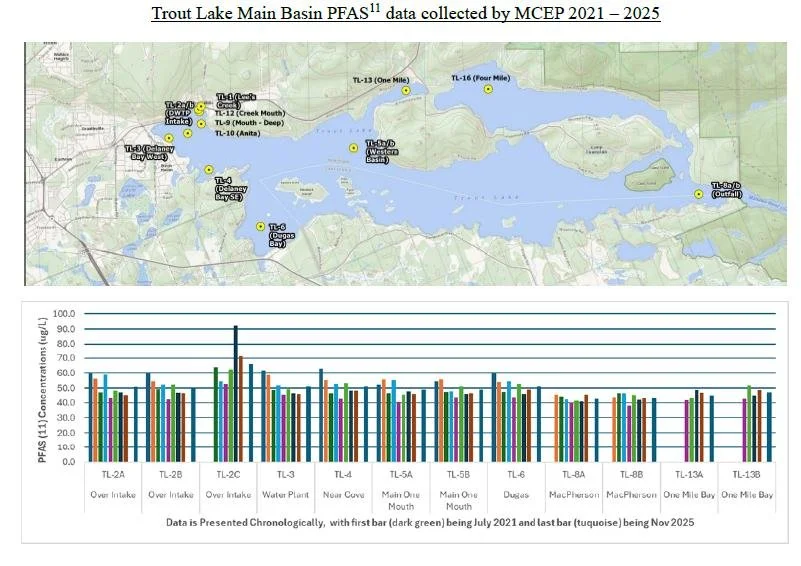
All recent PFAS data from the Ministry of Climate, Environment and Parks (MCEP) for Trout Lake (two sampling events occurred in each of 2021, 2023, 2024, and 2025) was obtained and reviewed. Trout Lake is sampled at multiple locations and, in some cases, at multiple depths. Sampling is usually done twice per year in July and November. Over time MCEP has added stations or started to sample at multiple depths, so variations in the numbers of samples may skew results slightly. Results are for the sum of 11 different PFAS chemicals which makes up the Provincial Interim Advice Value (note that new federal guideline for 25 PFAS chemicals would be comparable as most of the additional chemicals are non-detectable). This data was used in MCEP’s presentation at the PFAS Public Open House at the Best Western in November.
At face value the data shows a slight decline in PFAS levels in Trout Lake over time. We note that the decline predates remediation work at the Airport. On average the western half of the main body of Trout Lake is averaging 50 ng/L of PFAS11 (2021-2025) which is slightly lower than previously reported. The only sampling site at the east end of Trout Lake (TL-8 between Camp Island and the MacPherson Boat Launch) is averaging ~ 43 ng/. Turtle Lake is averaging ~ 25 ng/L. One Mile Bay has equivalent levels to the western main basin. Four Mile Bay (a single sample) shows that PFAS is barely detectable. Lees Creek, at the Highway 63 bridge, is averaging 221 ng/L over the same period.
One reasons we are hesitant to say, definitively, that PFAS is declining in Trout Lake is because of the way in which PFAS loading to the lake works. PFAS’s main route to Trout Lake is via Lees Creek. Under normal flow conditions both PFAS levels and volume of contaminated water entering Trout Lake is relatively moderate, but both spike during heavy runoff periods. When flow conditions are low, PFAS chemicals are deposited in stream sediment or at the edge of the stream. After rainfall events deposits are remobilized by increased flows which increases loading of PFAS to Trout Lake (both quantity and quality). In both 2024 and 2025 we experienced prolonged drought conditions which could mean lower values are due to the lack of rainfall/runoff.
If you recall, Trout Lake had very low water levels late last summer and in the early fall due to prolonged drought conditions. In fact, the North Bay Mattawa Conservation Authority issued a Level 1 Low Water Advisory in early September (for the region) and, subsequently, on October 13, the Conservation Authority issues Level II Low Water Advisory as the period of minimal rainfall lingered. MCEP sampled Trout Lake in late July, as the drought started, and at the start of November 2025 just as it ended. There was a sprinkle several days before the fall sampling event but Lee Creek runoff would still be modest. This sprinkle did generate some runoff to the extent Station TL-1 (at the Highway 63 bridge) recorded its second highest PFAS reading in all of the samples reviewed. This relatively minor event would not likely affect any sampling station that are not near the mouth or Lees Creek. Overall, the quantity of PFAS being discharged to Trout Lake in recent sampling years may be below normal because of below normal runoff at times of sampling. So, we need to keep taking samples and see what happen in a normal runoff year.
Our conclusion is that the cleanup of PFAS contamination in the Lees Creek headwaters is not yet having any significant impact on PFAS levels in Trout Lake.